
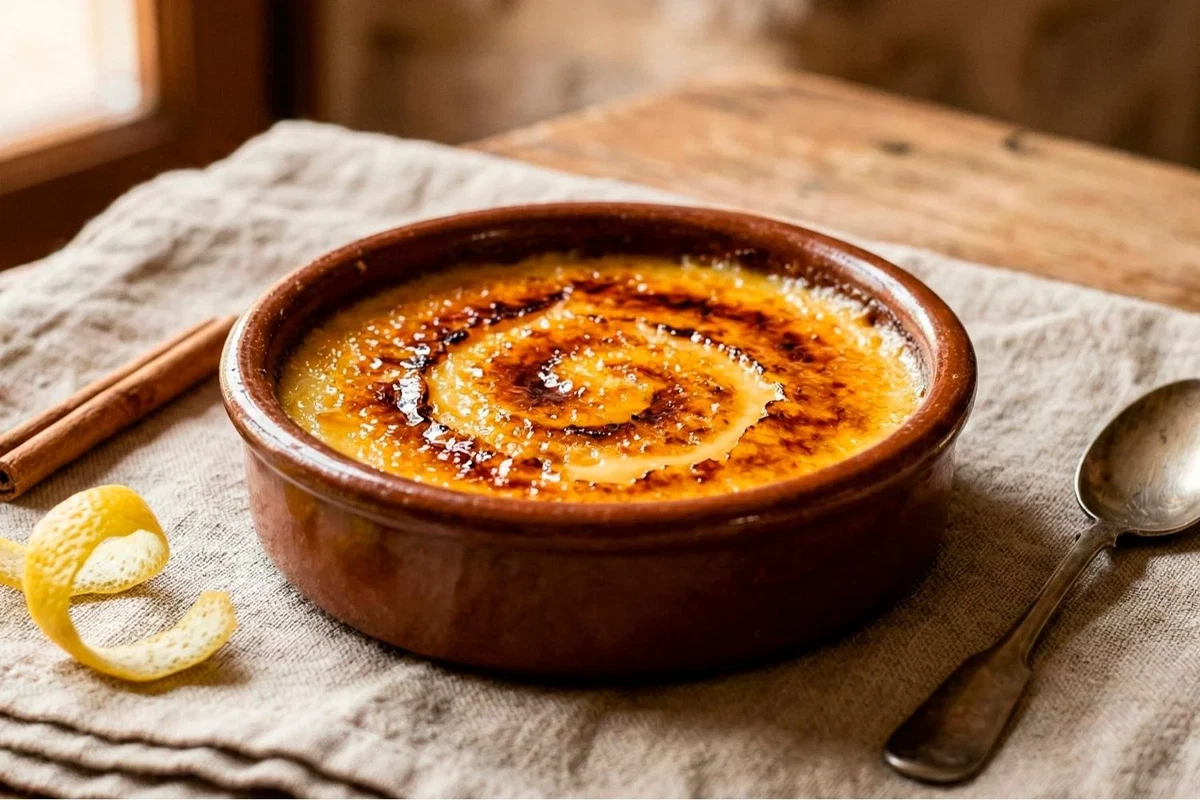
For me, without a doubt, the homemade crema catalana is much more than a dessert. This traditional crema catalana recipe It is home, tradition, and family. Its flavor has stayed in my memory since I was very little and, to this day, it is still a celebratory dessert that fills me with nostalgic happiness with every spoonful.
Today I'm going to share a bit of their story with you, and I'll also tell you what is in crema catalana and how to make crema catalana at home, which I’m sure is how it’s done in many other homes too, because it is a Traditional recipe. Although essentially the ingredients for crema catalana or Saint Joseph's cream they are the same in every home, and it is usually flavored with lemon; some people make it with orange, mandarin, and even lime. With the peel of any of these citrus fruits, the result is delicious.
But what is undoubtedly a cause for debate is the finishing touch. Because I assure you there are so many passionate defenders of the burnt crema catalana as supporters of the unburnt Catalan cream. Since it is completely optional and burns before serving, things never get out of hand because everyone can order it however they want and enjoy it however they like best.

A bit of the history of crema catalana
Although it can be eaten any day of the year, without a doubt Catalan cream is the quintessential traditional dessert for Saint Joseph's Day (Father's Day). It is also known as burnt cream or St. Joseph's cream. It used to be made around this time of year, on the doorstep of spring, which is when hens usually lay more eggs. In country homes, this surplus was used up in all kinds of desserts, and one of the most widely made was Catalan cream. A wonderful leftover recipe!
It appears in 14th-century recipe books as "cooked milk" and is considered one of the oldest desserts in Europe in its category. In addition, like all traditional recipes, the origin of its name has a legend behind it, in this case based on a bishop's visit to a convent. The nuns made a flan to offer to the bishop, but it turned out more liquid than expected and, to fix it, they added a layer of burnt sugar. The bishop tasted it and burned himself, saying: "Cream, cream!", (which translated into Castilian is: burn!, burn!).
Tips for making perfect crema catalana
The crema catalana recipe is simple, but to make it turn out perfectly, it's worth following these tips:
- Most importantly, without a doubt, use the highest-quality ingredients. Both the eggs and the milk are the foundation of this recipe. The milk should be whole and, if possible, fresh. And the fresher the eggs are, the better the result will be.
- The starch or cornstarch must be completely dissolved, so that no lumps form.
- You have to infuse the milk well with the lemon zest (without the white part) and the cinnamon. Once it comes to a boil, let it sit for at least 15 minutes.
- The cream it should be cooked over low heat, it should never boil to prevent the egg yolks from curdling and lumps from forming.
- It is very important stir constantly the cream with a spatula or a wooden spoon.
- When it is ready, it is recommended strain the cream through a fine-mesh strainer while you divide it among the small dishes, in case there are any remnants or small lumps.
- The cream should be served cold. Ideally, prepare the custard a day ahead; it shouldn't be eaten hot, and the flavors settle.
- It must be caramelize the sugar right before serving the custard, not before, to prevent it from softening.
Catalan cream recipe
Without further delay, let's get to what really matters, the homemade crema catalana recipe. Although it is a Traditional recipe, very simpleit takes a little time to cook the custard, and a little patience too, to wait for it to cool so you can enjoy it, caramelized or not! I hope you like it so much that it becomes your Sunday dessert.
Ingredients
- 1 liter of whole milk
- 8 large egg yolks
- 200 g of sugar
- 50 g of wheat starch (or 40 g of cornstarch)
- 1 cinnamon stick
- The zest of one lemon (without the white pith)
Preparation
- From the liter of milk, set aside one cup or one glass and reserve it.
- Heat the rest of the milk in a saucepan over medium heat, along with the lemon peel and the cinnamon stick. When it comes to a boil, turn off the heat and cover the saucepan so the milk can infuse for a few minutes.
- Dissolve the wheat starch or cornstarch in the milk you set aside in the cup or glass. Mix well so there are no lumps left.
- Put the egg yolks and sugar in a bowl and stir well (without aerating) until the mixture is smooth and looks pale. Add the milk with the starch and stir well to combine everything.
- Remove the lid from the saucepan and heat the milk again until it comes back to a boil. Carefully add the egg mixture. Lower the heat and stir the mixture with a spatula or a wooden spoon.
- Let the cream cook, stirring constantly, always over low heat until it starts to boil (you'll see it begin to thicken).
- Remove from the heat, take out the lemon peel and the cinnamon stick, and quickly divide into some ceramic casserole dishes. Let the cream cool to room temperature and refrigerate it so it can chill.
- If you like a brûléed topping, just before serving add a generous amount of sugar on top and caramelize it with a typical kitchen torch or with a kitchen torch. If you prefer it unbrowned, serve as is.
- You can serve it with ladyfingers, cookies, or almond biscotti.
Suggestions
- If you prefer, you can serve the cream directly in a large ceramic mold instead of making it in individual ramekins or small casserole dishes.
- The egg whites, which are not used in the custard recipe, can be frozen for use in other preparations. You can store them in an airtight container or portion them into an ice cube tray. They’re perfect for making financiers, cat tongues, some wafer rolls, or these delicious meringue mille-feuille.



Comments
Claudia&Julia said:
Ciao Elena,
Siamo contenti che la ricetta ti sia piaciuta.
Cordiali saluti
Elena said:
Grazie mille!